The 97 › Strategy 5 › Quarter 1, month one · the foundation
Power Parthenon
The point
One pillar is not a business. It is an exposure you have not priced.

Why it matters
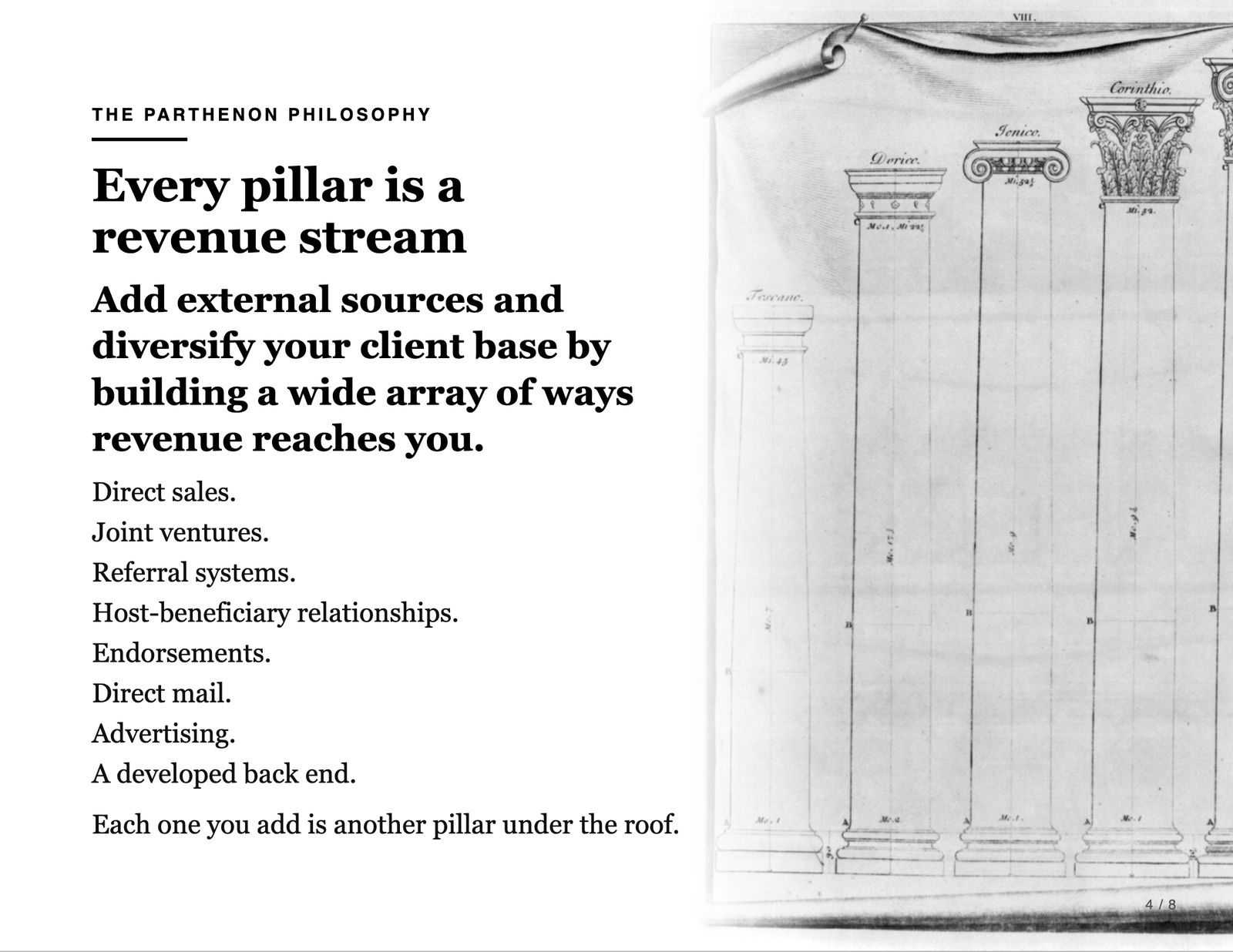
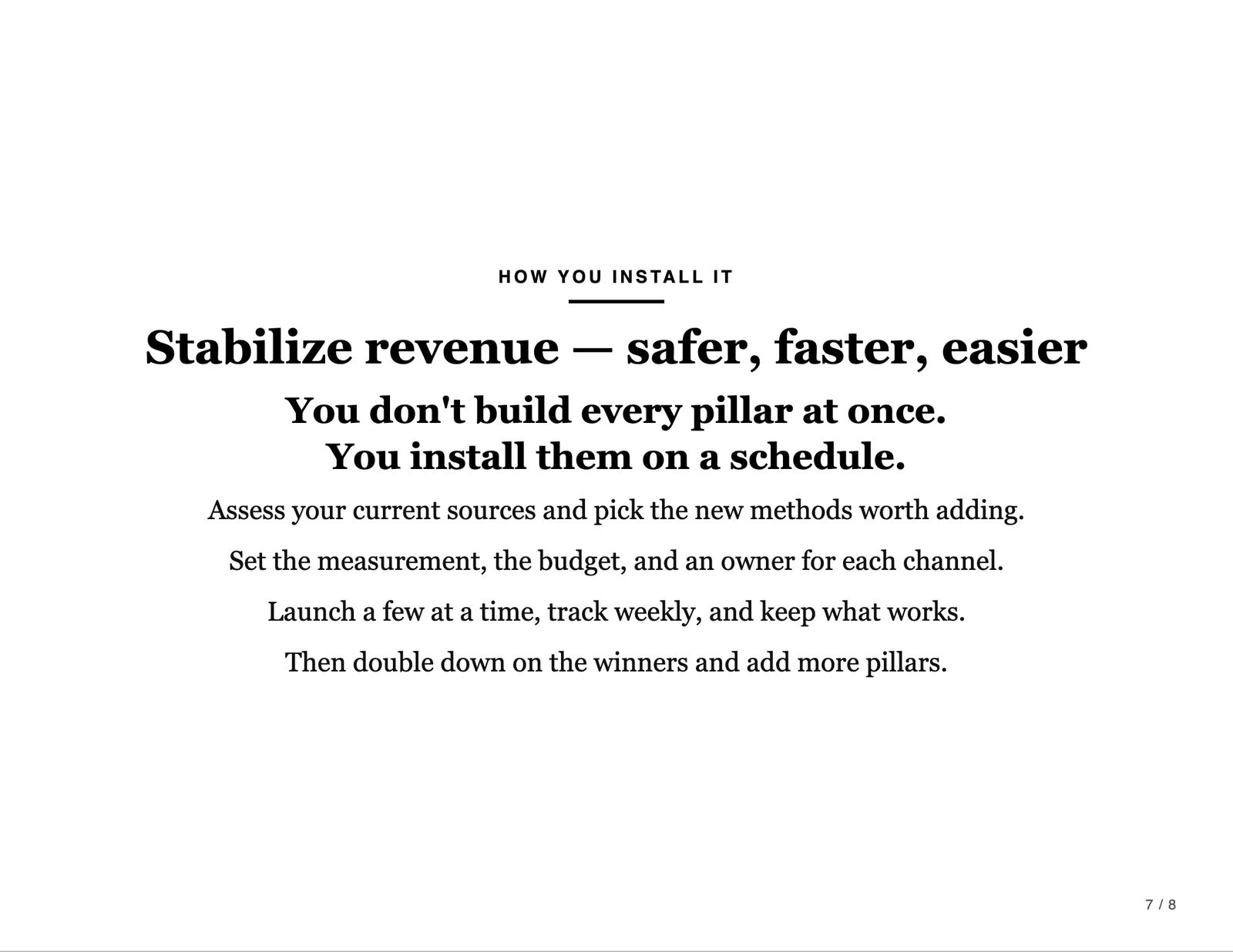
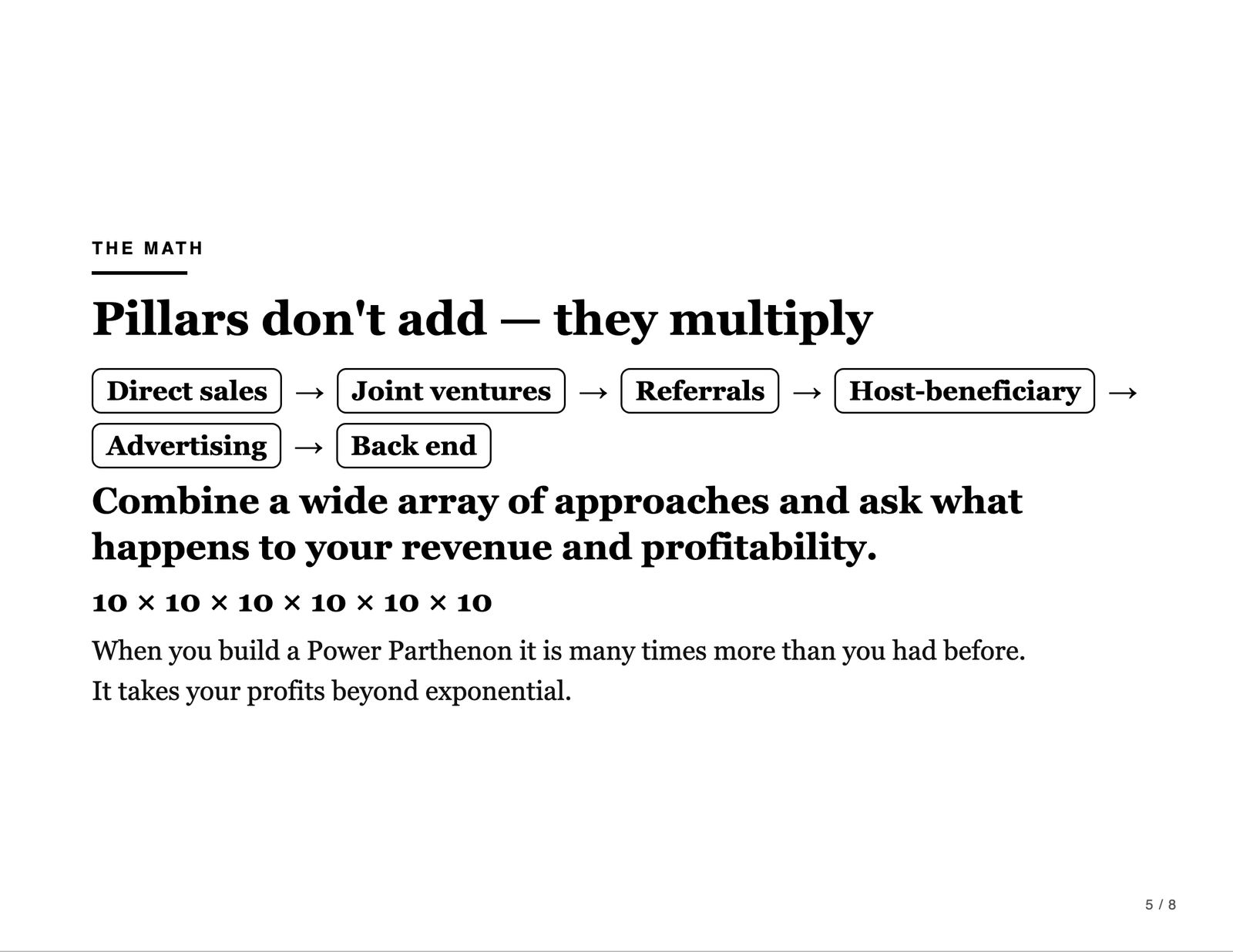
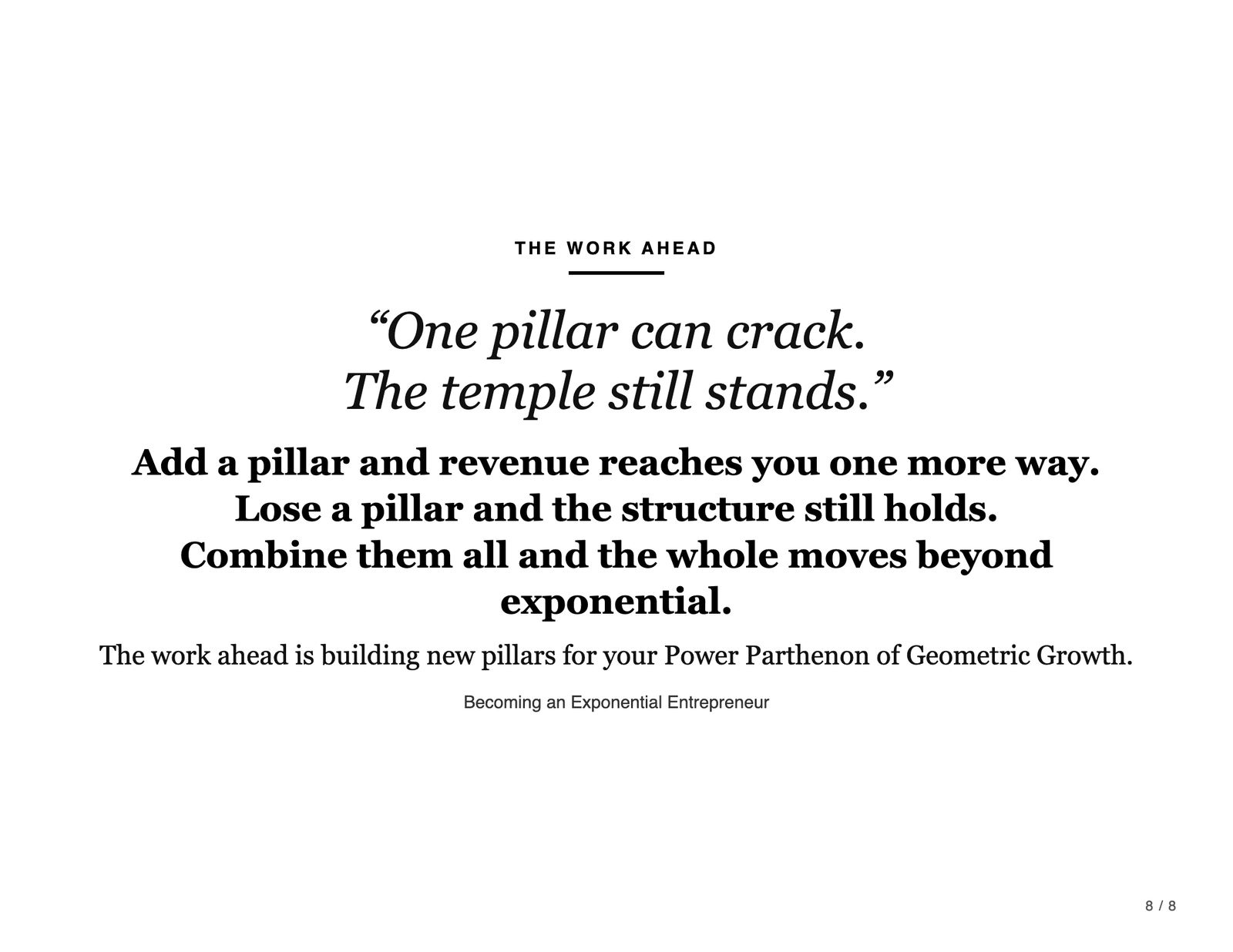
Jay draws the Parthenon because of what it is standing on. Many pillars, none of them individually critical, holding a roof that stays up when any one of them fails. Then he draws the alternative and calls it the diving board — a single plank, anchored at one end, and everything you have built standing on the far end of it.
Most businesses are diving boards. One product that carries the revenue, one channel that brings the clients, one client who is a quarter of the book, one person who knows how the thing actually works. It feels like focus while it is working, and every one of those is fine right up until the moment it is not.
The distinction that matters is that pillars are not diversification. Diversification spreads you thinner across unrelated things. A Parthenon adds revenue streams under the same roof, serving the same buyer, using what you have already built — which is why each new pillar is cheaper than the last rather than more expensive.
The mistake almost everyone makes
Building the second pillar out of something unrelated because it looked like a bigger opportunity. That is not a second pillar, it is a second business, and you now have two diving boards and half the attention.
The test: does the new stream use the buyer, the reputation or the infrastructure you already own? If it uses none of the three, it is a distraction wearing a strategy's clothes.
Where it shows up — fourteen worked examples
Eight of these are companies that got it wrong. That is deliberate — the failures are more instructive here than the successes.
| Company | What happened |
|---|---|
| Kodak | Organised its entire financial life around film even after inventing the digital camera. Bankruptcy, 2011. |
| Blockbuster | Six and a half thousand stores became the trap rather than the moat once desire moved to mail, kiosks and streaming. |
| Borders | Outsourced its online sales to Amazon in 2001 — and handed a competitor the next pillar. |
| BlackBerry | Secure email was a column, not a temple. Sales fell from twenty billion to barely two. |
| GoPro | A thrilling brand on one pillar. A product category is not a platform once phones improve. |
| Disney | One character becomes film, streaming, parks, merchandise, licensing, games and cruises — each pillar feeding the others. |
| Apple | Around the iPhone: Services, Wearables, the App Store, iCloud, Apple Pay, retail. A dominant pillar needs companions, not disappearance. |
| Berkshire Hathaway | Insurance float funds investments while railroads, energy, manufacturing and retail each earn — weakness in one rarely threatens the whole. |
| Sony | Reinvented from a consumer-electronics icon into PlayStation, music, film, anime, image sensors and financial services. |
| Tencent | A digital city inside WeChat — social, payments, gaming, advertising, mini-programs, enterprise tools at once. |
| Garmin | Refused to die with car GPS. Fitness, outdoor, aviation, marine and golf, to record revenue. |
| Deckers | Built HOKA into a second engine beside UGG rather than depending on one line. |
| O'Reilly | Serves DIY retail and professional repair shops from the same store, inventory and distribution. |
| A one-owner PT clinic | A surgeon referral moat, a profit-leak audit, and a borrowed fitness membership model. The small-business version. |
The challenge
Find the plank you are standing on.
Work out what percentage of last year's revenue came through your single largest channel, and what percentage came from your single largest client. If either is above forty, you have found it.
Do not fix it yet. Write both numbers where you will see them.